

In recent years, online education continues to be popularised. Sources outline that the worldwide market for online learning has grown by 900% since 2000.
Despite this growth, there is still a quiet assumption that online education is a lesser version of the on-campus experience – something you settle for when the real thing isn’t an option.
This assumption doesn’t hold up against the research, but endures because much online learning feels like an afterthought. Lectures, resources, assignments, quizzes – all uploaded to platforms that feel like plumbing, rather than the design.
The research on why online students disengage backs this up. According to a systematic review of dropout in online education, attrition was found to be shaped by a mix of course design, technology, and how supported a student feels. Not due to motivation or workload.
This leads us to the belief that a meaningful share of online dropouts isn’t a student problem – but an institution problem.
The Psychology: Why Presence Matters
The psychology behind why this happens is fascinating – and is simpler than we originally thought.
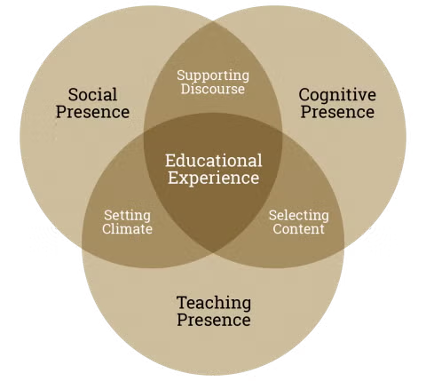
One of the most interesting ideas comes from the Community of Inquiry framework, developed by Garrison, Anderson and Archer. This structure argues that to engage in online learning, there are three key elements an institution needs to provide: teaching presence, cognitive presence, and social presence.
In short, a student needs to feel more like a human than a name on a spreadsheet through active, not passive, engagement. This is achieved through teaching style – which encompasses being guided through the experience, as opposed to letting students self teach.
Other researchers have looked into this idea through the lens of social presence in online learning – which debates exactly how these presences interact. The underlying point holds – students who feel like they’re somewhere, rather than just watching something, tend to stay more engaged and learn more deeply.
This is where the online vs on campus comparison is framed the wrong way. On campus, a confused student can turn to another student or raise their hand. Online, the barriers can be more prolific. This is where the course and the delivery need to be thoughtfully crafted – with appropriate UX design, psychological science, and thorough development solving the same problem from day one.
Torrens University Australia: A Case Study in Industry Excellence

Torrens University Australia is renowned for its online learning experience, with its platform, MyLearn, at the forefront of the success. Its Bachelor of Psychological Science degree, delivered through the platform, won the 2024 ASCILITE Innovation Award for embedding XR and simulation directly into the curriculum rather than adding it on as a novelty.
For this degree, a student can log into a virtual clinic from home and work through a series of scenarios as if they were physically in the room. A virtual brain and behaviour unit lets students manipulate and explore concepts rather than just read about them. There is also a range of simulated HR scenarios that give students a low-stakes way to practise difficult conversations before they have to do it for real.
This approach doesn’t replace the importance of text or video. Instead, it gives students something text and video can’t – a sense of being somewhere and doing something. This distinction lines up with broader research that outlines the importance of immersive learning in online environments.
The Bigger Lesson

The gap between online learning and on-campus learning doesn’t need to be so stark. The fix is treating the gap that exists between online learning and on-campus learning.
This can’t be achieved by adding more features and more content. Rather, it’s about treating the online experience as its own design challenge from the start – through psychology, design, and smart engineering.
Institutions that keep treating online delivery as a distribution channel for existing content will keep producing courses that feel like a compromise to students. Frankly, it’s unfair.. The institutions that build with intent, and that carefully think about how a student feels throughout their experience, are the ones that will make online learning stop feeling like the fallback option – and start feeling like a considered way to learn.