
The mandate for technology leaders has expanded well beyond building great software. If your company touches physical goods at any point – whether you sell hardware, operate an e-commerce brand, or enable other businesses to do so – fulfillment is now your problem. Not ops. Not logistics. Yours.
Consumer expectations set the stakes clearly. According to cart.com’s 2025 Fulfillment Industry Report, 56% of consumers expect same-day or two-day delivery as a standard option, and 38% abandon orders when delivery takes more than a week. These aren’t edge cases. They’re the baseline your customers are measuring you against.
The technology leaders gaining ground in 2026 are the ones who stopped treating fulfillment as a back-office cost and started treating it as a competitive infrastructure decision. Here’s what that shift actually looks like.
Fulfillment as a technology decision, not just an operations problem
For decades, fulfillment sat firmly in the operations column. Warehouses were managed by ops teams, and technology leaders rarely weighed in. That’s changing fast. CTOs and VPs of Engineering are now being asked to evaluate warehouse management systems, robotics integrations, and API-connected logistics networks as part of their core infrastructure stack.
Gartner’s 2025 supply chain research shows that over 50% of supply chain organizations now have a technology leader reporting directly to the Chief Supply Chain Officer. And according to Gartner (2025), 82% of Chief Supply Chain Officers plan to increase supply chain technology investment in the near term – meaning technology teams are being handed the budget and the accountability together.
This isn’t just a structural shift inside companies. It’s also a geographic strategy question. When a growth-stage company wants to reach customers in the Midwest, Southeast, or Pacific Northwest faster, selecting the right US fulfillment center network becomes a product decision with real delivery-time implications – not a vendor management task. Location, API compatibility, and throughput capacity matter as much as price per unit.
Understanding how this decision fits into the broader investment shift is worth examining – and how AI is reshaping business investment decisions helps frame why capital is flowing into supply chain tech at this scale.
The automation surge: what the numbers actually say
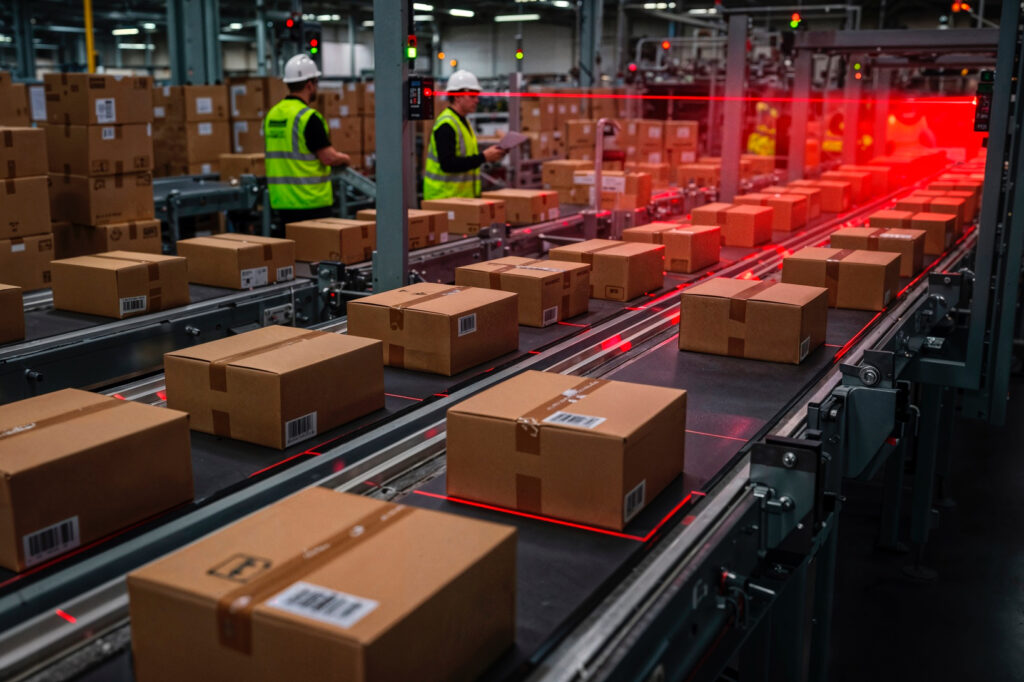
Warehouse automation isn’t a future-state discussion anymore. According to the Logistics Management 2025 Automation Survey, automation penetration reached 24% of North American warehouses in 2024 – up from just 5% a decade earlier. By 2027, 75% of companies are expected to have implemented some form of warehouse automation. The pace is sharp.
The market is responding accordingly. The North America E-Commerce Fulfillment Services Market is estimated at USD 47.57 billion in 2025 and is projected to reach USD 81.14 billion by 2030, at a CAGR of 11.27%, according to Mordor Intelligence’s 2025 market report. That growth is being driven largely by investment in automation, not just by volume increases.
For technology leaders, the ROI case is direct. The same Logistics Management 2025 Automation Survey projects approximately 4 million warehouse robots deployed across 50,000+ facilities by the end of 2025 – enabling continuous operations that human-only facilities simply can’t match. The companies pulling ahead aren’t just adopting automation tools – they’re integrating them with the same engineering discipline they’d apply to any core platform infrastructure.
This connects to a broader pattern of how automation is driving change in business operations across sectors. Fulfillment is catching up to where enterprise software has been for years.
How 3PL networks give tech leaders a scalable edge
Owning fulfillment infrastructure outright is capital-intensive and inflexible. Building and maintaining your own warehouses locks in cost before you know where demand will land. Third-party logistics (3PL) networks solve that problem directly.
The results are measurable. Companies partnering with 3PLs report a 29% improvement in on-time delivery and a 28% reduction in cost per order, according to wedosupplychain.com’s 2025 ecommerce fulfillment analysis. That’s not a marginal efficiency gain – it’s a structural advantage for companies competing on delivery speed.
The smartest operators are also thinking geographically. Proximity to high-density metro areas directly reduces last-mile delivery times and costs – which is why warehouse placement is increasingly treated as a strategic decision rather than a real estate afterthought. But choosing where to place fulfillment nodes isn’t just a logistics call – it’s a market entry question. Knowing how to do market research for a target region before committing to a fulfillment location is the kind of upstream thinking that separates reactive scaling from intentional geographic strategy.
The best technology leaders aren’t just plugging in 3PL vendors. They’re treating the selection and placement of fulfillment nodes like a product rollout – researching demand patterns, testing in high-density markets first, and expanding based on data rather than assumptions.
Speed, data, and the customer expectation gap
Technology leaders who’ve closed the fulfillment gap share a common habit: they treat delivery performance as a product KPI rather than a logistics metric. Pick accuracy, delivery windows, return rates – these get tracked the same way they’d track NPS scores or application uptime.
According to Gartner’s 2025 supply chain technology research, by 2026, 75% of large enterprises will have adopted AI-powered supply chain solutions. That adoption is being driven by a real problem: the gap between what customers expect and what legacy operations can actually deliver. AI-driven inventory tools and real-time demand forecasting are the instruments closing that gap – and the pattern is clear: earlier adopters are building a supply chain advantage that compounds over time.
Speed matters, but it’s not the whole equation. Chasing faster delivery at any cost creates its own risks – overextended infrastructure, unsustainable carrier contracts, and carbon footprints that conflict with corporate sustainability commitments. Balancing innovation with operational responsibility is a tension that forward-thinking leaders are navigating deliberately, not ignoring.
The companies that win at fulfillment over the next three years won’t be the ones with the largest warehouse footprint. They’ll be the ones with the best data infrastructure.
What smart technology leaders do next
Fulfillment is no longer a back-office cost center. It’s a customer-experience platform and a competitive technology asset – and the leaders who recognized that early are already pulling ahead on delivery speed, cost structure, and customer loyalty.
The practical step isn’t complex. Audit your current fulfillment setup against the benchmarks your customers actually hold you to. Can your infrastructure handle a 2x volume spike without degrading delivery time? Are your 3PL partners API-connected enough to give you real visibility? Is your warehouse footprint positioned for where your customers are – not where they were three years ago?
These are engineering questions now. Treat them that way.