
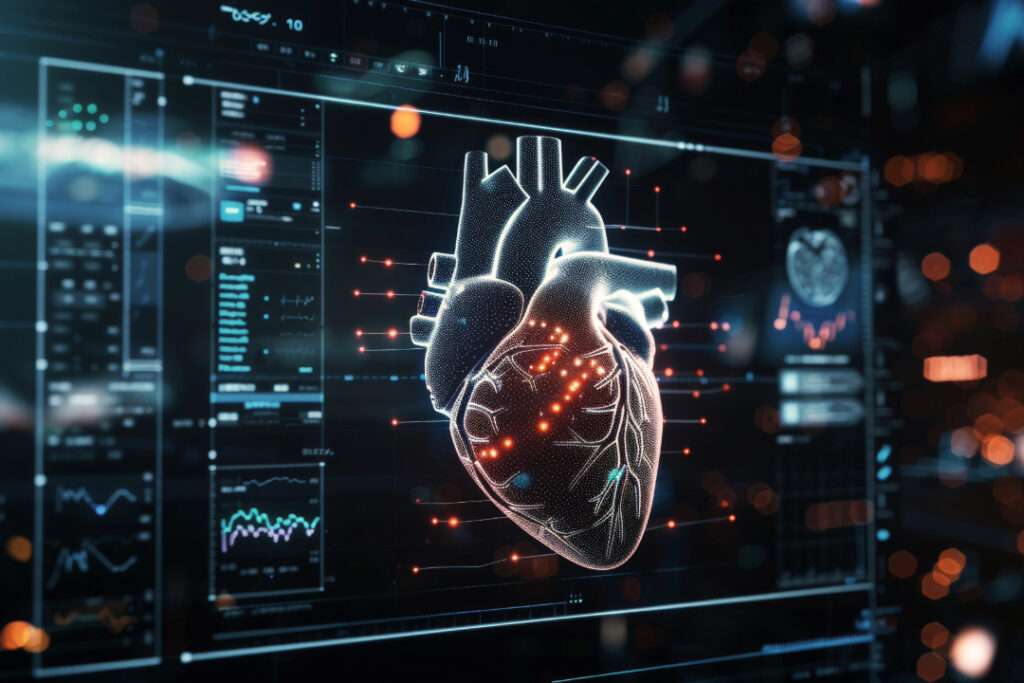
When Grey’s Anatomy first showed a holographic heart hovering over an operating table, it felt like science fiction. Today, it is rapidly becoming the future of cardiology. Cardiovascular disease remains the leading cause of death globally, accounting for nearly a third of all fatalities. Yet the way we study, diagnose, and treat the heart is being transformed by in silico medicine – advanced computer simulations that allow us to recreate one of the body’s most vital and complex organs.
The human heart is uniquely challenging to study. How do you safely investigate an organ that beats around 100,000 times a day, over 3 billion times in a lifetime? Traditional approaches rely heavily on animal models and human clinical trials – both essential, but limited in scope, costly, and sometimes ethically fraught. In contrast, virtual heart models allow researchers and clinicians to observe the unobservable, test the untestable, and experiment without endangering a single patient.
Beyond anatomy - digital twins of the human heart
Every heart is unique – from its geometry and rhythm to the way blood flows through its chambers to the complex systemic interactions that modulate its behaviour. This individuality means that personalised cardiac disease management, also called precision cardiology, may significantly improve the efficacy of treatment of cardiovascular disease. The promise of in silico medicine lies in creating a digital twin, a personalised, virtual copy of a patient’s heart that mirrors their physiology in astonishing detail.
These digital hearts can be treated, stressed, repaired, or pushed to failure in ways no physician could ever attempt on a living patient. The insights gained enable doctors to predict how a heart will respond to specific interventions – whether a new drug, a surgical procedure, or the implantation of a device –before the treatment is attempted in the clinical theatre.
From television fiction to clinical reality, the digital heart represents one of the most significant frontiers in modern medicine.
The ability to run simulations of a patient specific digital twin can help clinicians make better informed decisions, improve preoperative planning, and enhance outcomes. This is particularly valuable when treating complex conditions such as congenital heart disease or heart failure, where patient variability presents challenges for conventional approaches.
Reducing the time frame for patient specific heart modelling
Recent advances in AI and simulation technologies are dramatically accelerating the process of creating digital twins of the heart. What once took weeks of painstaking modelling can now be achieved much quicker. These tools can capture detailed geometric changes of the heart during a heartbeat. When combined with measurements of the electrical activation, they provide critical insights into heart functions, from electrical activation to tissue contraction and blood flow, enabling researchers and clinicians to generate patient specific heart models with unprecedented speed and accuracy.
For example, here at Ansys we have developed the PyAnsys Heart platform, which combines AI with advanced simulation to help streamline the modelling process. By reducing timelines from weeks to minutes, PyAnsys Heart illustrates how digital twins are already moving from concept to reality, offering a glimpse of what the future of personalised treatment planning could look like.
Do you need a PhD in computational mechanics to run a heart model?
As with most technological breakthroughs, adoption can be slowed if tools are too complex for everyday use. But advances in standardisation and AI driven automation are making sophisticated heart modelling far more accessible. Returning to the PyAnsys Heart example, the platform uses AI to simplify and automate the modelling process, turning what was once a highly specialised task into something that can generate accurate and detailed visuals in a matter of minutes. This allows cardiologists, cardiac surgeons, electrophysiologists and their clinical support staff to apply their expertise and derive insights from the simulation process without needing advanced simulation training.
A new era for regulation and clinical trials
One of the most profound changes in recent years has been the growing acceptance of simulation as regulatory evidence. Both the US Food and Drug Administration (FDA) and the European Medical Device Regulation (MDR) now recognise in silico modelling as part of submissions for new cardiovascular therapies and devices.
This marks a significant turning point. By validating simulation as a credible source of evidence, regulators are enabling companies and researchers to reduce reliance on large, lengthy, and sometimes risky human trials. In addition, in silico clinical trials can combine data from bench testing, pre-clinical, and clinical studies and run virtually, across thousands of digital patients, to test safety, efficacy, and performance.
These trials offer several advantages. They are faster, more cost effective, and inclusive of patient diversity in ways traditional trials struggle to achieve. For example, digital populations can be designed to reflect rare conditions or demographic groups that are often underrepresented in real world studies.
Engineering the beating heart
The complexity of modelling the heart is immense. It requires simulating not only the intricate geometry of valves, arteries, and chambers, but also the physics of blood flow, the biomechanics of tissue, and the electrochemistry of cardiac rhythm.
The heart is not just a pump. It is an electromechanical system, where signal conduction and mechanics are intimately connected. Capturing this requires advanced, coupled, multiphysics modelling – ideally one tool capable of representing fluid dynamics, structural mechanics, and electrophysiology simultaneously.
This approach is already driving innovation in devices such as artificial hearts, pacemakers, and stents. For example, a total artificial heart must mimic the natural heart’s performance under a wide range of physiological conditions, from resting to intense exercise. Virtual testing allows engineers to simulate these scenarios comprehensively, ensuring safety and performance before a device is implanted in a patient.
From prevention to personalisation
Looking forward, digital twins of the heart will revolutionise not only treatment but also prevention. Imagine a patient at risk of heart disease being given a digital model of their heart, updated regularly with data from wearable sensors or imaging scans. Their physician could monitor changes in real time, testing lifestyle adjustments or treatments on the virtual heart before recommending them. Patients could also understand the consequences of their decisions and how to mitigate them in their daily lives.
Such personalised, proactive care would move us away from reactive medicine – intervening only once disease has progressed – and towards continuous, preventative management of cardiovascular health.
The ethical frontier
With such transformative potential come important ethical considerations. Patient data privacy, equitable access to advanced digital tools, and ensuring models are free from bias will all be critical as we move towards widespread adoption. Regulators, clinicians, engineers, and ethicists will need to collaborate to ensure that the benefits of in silico medicine are shared fairly and responsibly.
The future of cardiology
From television fiction to clinical reality, the digital heart represents one of the most significant frontiers in modern medicine. In silico modelling is no longer confined to research labs – it is being recognised by regulators, trusted by clinicians, and increasingly used to improve outcomes for patients worldwide.
On this World Heart Day, it is worth reflecting that while cardiovascular disease remains the planet’s biggest killer, we are now armed with tools that could change the trajectory of heart health for generations to come. The holographic heart is no longer a fantasy – it is the digital twin beating on the horizon of cardiology.

Dr. Mark Palmer
Dr. Mark Palmer is Lead Chief Technologist for Healthcare, Ansys Technical Fellow, Ansys, now part of Synopsys. A Distinguished Scientist, Dr. Palmer works across the core business units, customer excellence, sales, marketing, and research and development to advance technologies of strategic importance for the healthcare sector. Dr. Palmer is a recognised expert in the field with more than 30 keynote or invited lectures and over 40 journal publications and refereed conference papers.