
The transition of 3D printing from a hobbyist’s curiosity to a cornerstone of industrial manufacturing represents one of the most significant shifts in modern engineering. Once restricted to small-scale plastic prototypes, additive manufacturing is now being deployed at an industrial scale to redefine how we build everything from aerospace components to residential housing.
By leveraging advanced materials such as specialised metals and high-performance concrete, 3D printing offers a compelling alternative to traditional manufacturing and construction methods. This shift is driven by a need for greater design flexibility, cost-efficiency in complex projects, and, most importantly, a substantial reduction in the environmental footprint of the global construction industry.
Moving beyond the hobbyist - Industrial scale and specialised applications
At the industrial level, 3D printing operates far beyond the capabilities of consumer-grade desktop units. In industrial settings, the technology is utilised to produce vast quantities of parts or highly specialised, regulated components. This is particularly evident in sectors where precision and safety are paramount, such as the aerospace and maritime industries.
In these highly regulated fields, the ability to print parts on demand allows for a level of customisation that traditional assembly lines cannot match. Rather than maintaining massive inventories of spare parts – which requires significant warehouse space and energy – industrial 3D printing enables “just-in-time” manufacturing. This capability ensures that a single specific need is met by a single specific part, effectively eliminating the systemic overproduction that characterises traditional industrial models.
3D printing in metal - Precision and material efficiency
One of the most transformative applications of industrial 3D printing is found in metal fabrication. To understand its impact, it is best to compare it to CNC machining, which is fundamentally a subtractive process. In traditional CNC work, engineers typically start with a solid block, or “billet,” of metal and remove material to produce the final part. This process is inherently limited by tool access and inevitably generates significant scrap material, or “shavings,” resulting in industrial waste.
In contrast, metal 3D printing is an additive process that places material only where it is strictly necessary. While the process itself can be more expensive than conventional methods, it introduces a revolutionary concept known as topological optimisation. This engineering approach uses software to calculate the most efficient distribution of material to meet specific load-bearing requirements.
Topological optimisation often results in organic, tree-like structures that are hollowed out or “evacuated” in non-critical areas. By depositing material precisely as required, manufacturers can create parts that are lighter and stronger than their solid counterparts. This efficiency provides several key benefits:
- Material economy: significant reduction in raw metal consumption by avoiding the “skeleton” waste of traditional cutting.
- Design freedom: the ability to create complex geometries, such as internal cooling channels or intricate arches, that would be impossible to manufacture using standard protocols.
- Industrial performance: in industries like luxury goods or specialised machinery, the aesthetic and practical benefits of these optimised designs often outweigh the higher initial production costs.
The future of housing - Concrete 3D printing
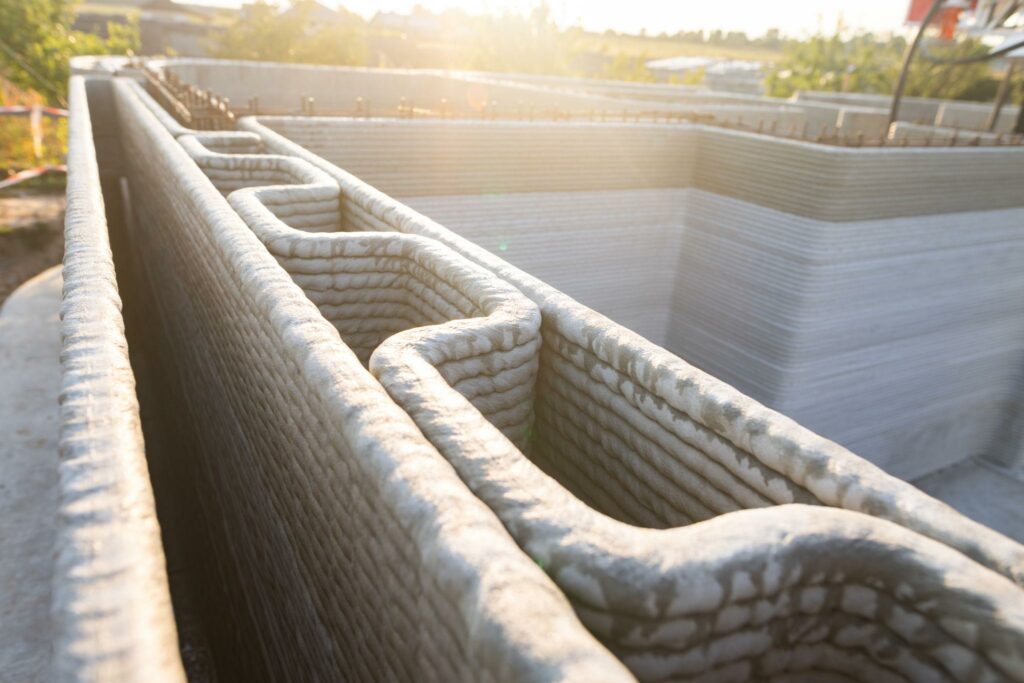
Perhaps the most visual representation of 3D printing’s industrial scale is the construction of residential housing. This application replaces the manual labour of laying parpaings (cinder blocks) with large-scale robotic automation.
The process typically involves a truck arriving at a construction site with a large robotic arm. This arm essentially functions like a “supersized pastry bag,” extruding liquid concrete in precise layers according to a digital blueprint. This method, often referred to as Fused Deposition Modelling (FDM) for concrete, builds the structure from the ground up.
Housing construction via 3D printing offers distinct advantages over traditional masonry:
- Speed of execution: robotic systems can operate continuously, completing the structural shell of a home significantly faster than a traditional human crew.
- Architectural flexibility: traditional construction is often limited to the “Lego-style” stacking of rectangular blocks. 3D printing allows architects to move away from these standard codes, enabling the creation of curved walls, round houses, and complex arches without the need for expensive custom formwork.
- Modular design: the technology enables modular construction, in which sections of a home can be printed with high precision and easily integrated on-site.
Environmental benefits
The move toward 3D printing in construction is heavily motivated by its potential to improve the industry’s environmental record. While the technology is not without its challenges, its benefits in sustainability are multifaceted:
Reducing Overconsumption and Waste
The primary environmental advantage of 3D printing is the shift from mass production to on-demand production. Traditional manufacturing often involves producing large batches of parts to achieve economies of scale, leading to overproduction and eventually waste when those parts are not utilised. Additive manufacturing ensures that energy and raw materials are only expended for “one piece, one need”. Furthermore, by using the exact amount of material required for a part or a wall, the technology minimises the physical waste common in both metal workshops and construction sites.
Energy Efficiency
By producing only what is necessary and optimising the weight of parts through topological optimisation, 3D printing reduces the overall energy consumption of the manufacturing lifecycle. Lighter components in the maritime or aerospace sectors also lead to lower fuel consumption over the vehicle’s operational life.
Advanced Insulation and Local Adaptation
In the housing sector, 3D printing allows for a radical rethink of thermal performance. Traditional walls are often limited by the standard materials available, such as glass wool and plasterboard. With 3D printing, the internal structure of the walls can be designed to accommodate a variety of insulators, including traditional or bio-sourced materials like lime, which were used in the past but fell out of favour due to modern standardised building protocols.
This flexibility allows for regional adaptation. A home printed in a Mediterranean climate can have its wall density and insulation type optimised for heat reflection, while a home in a northern climate can be printed with different specifications for heat retention. This level of customisation ensures that the building is as energy-efficient as possible for its specific environment.
Challenges and considerations
Despite its promise, industrial 3D printing is still navigating several hurdles. In the metal sector, the cost of additive manufacturing remains high compared to traditional methods, largely due to the price of metal powders and the specialised machinery required. While prices are justified for luxury or high-performance parts, they remain a barrier for mass-market adoption.
In housing, while robotic concrete deposition is innovative, the process can sometimes be slower than traditional block-laying, depending on site complexity and the specific concrete mix used. Additionally, while 3D printing reduces material waste, the environmental impact of the concrete itself – specifically the carbon emissions associated with cement production – remains a concern that the industry must address by exploring alternative, “greener” liquid binders.
Conclusion
Industrial 3D printing represents a fundamental shift in the “standard” manufacturing protocols that have dominated the last century. By moving material science into an additive, on-demand, and optimised era, the technology offers a path toward a more sustainable and architecturally diverse future.
Whether it is by creating complex, lightweight metal components for aerospace or by printing regionally adapted, energy-efficient homes, 3D printing is proving that the benefits of industrial-scale additive manufacturing extend beyond speed – it is about building smarter, with less waste and a renewed freedom of design.